Fibi AI Agent reporting
Measure Fibi AI Agent deflection, resolution, escalations, handoffs, and customer satisfaction with the built-in Fibi AI Agent report template.
Written By Markus Palm
Last updated 8 days ago
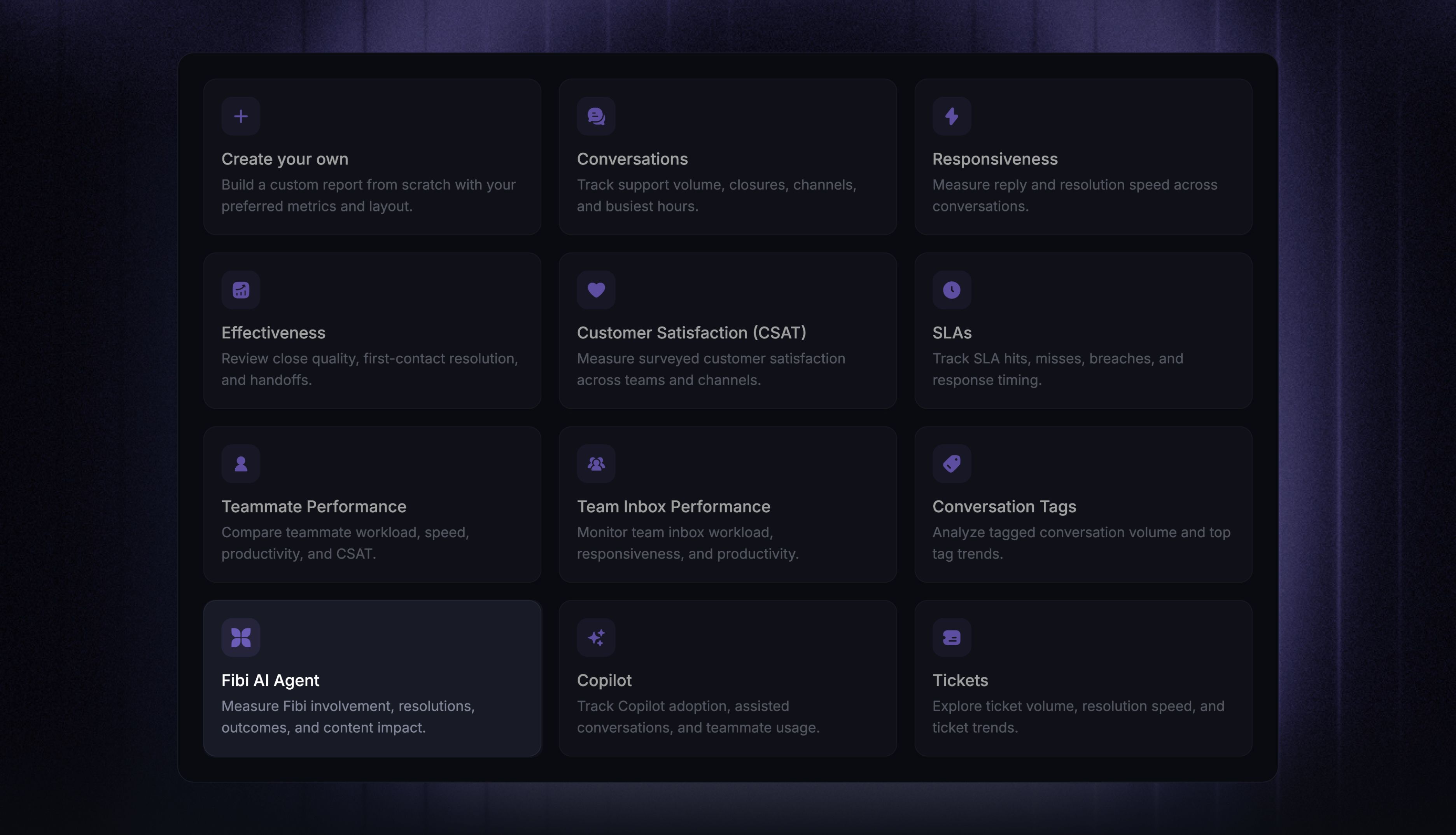
Overview
The ‘Fibi AI Agent’ template shows how much of your support Fibi handles on its own and how well it does it:
How often Fibi gets involved
How many conversations it deflects and resolves
Where it hands off to teammates
How customers rate it
Go to the Reports tab and create a new report. Select the ‘Fibi AI Agent’ template to get started quickly.
Note: You can also combine reporting metrics and attributes to create your own custom report.
Headline metrics
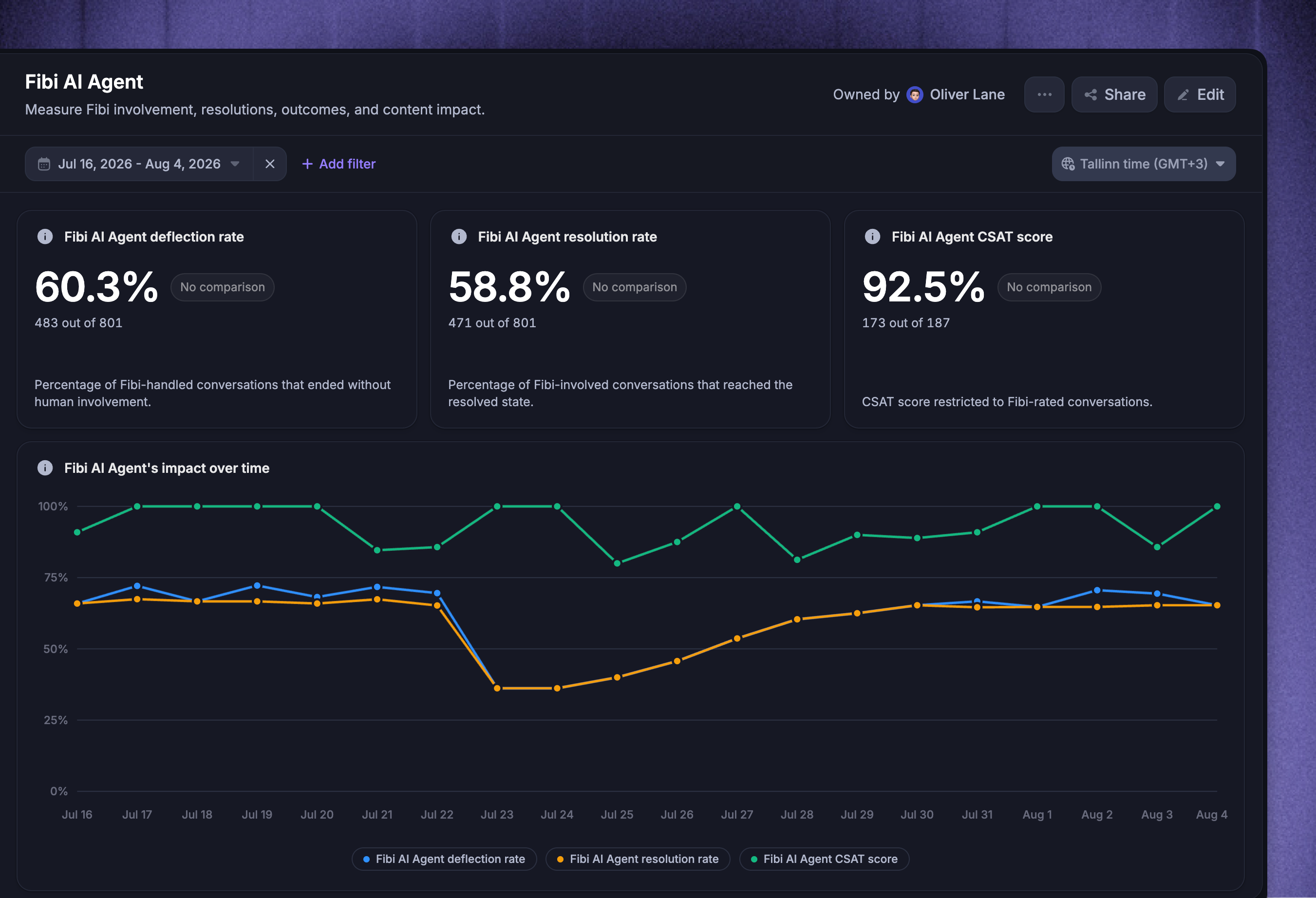
The top of the report answers the three questions that matter most:
‘Fibi AI Agent deflection rate’ - the percentage of Fibi-handled conversations that ended without human involvement
‘Fibi AI Agent resolution rate’ - the percentage of Fibi-involved conversations that reached the resolved state
‘Fibi AI Agent CSAT score’ - the percentage of positive ratings out of all Fibi ratings
‘Fibi AI Agent's impact over time’ trends all three on one line chart, so you can see whether changes to Fibi's content and configuration actually move the numbers.
Tip: Hover the info icon next to any chart title to check its metric definition, Timestamp, Aggregation, and applied filters.
Fibi AI Agent involvement
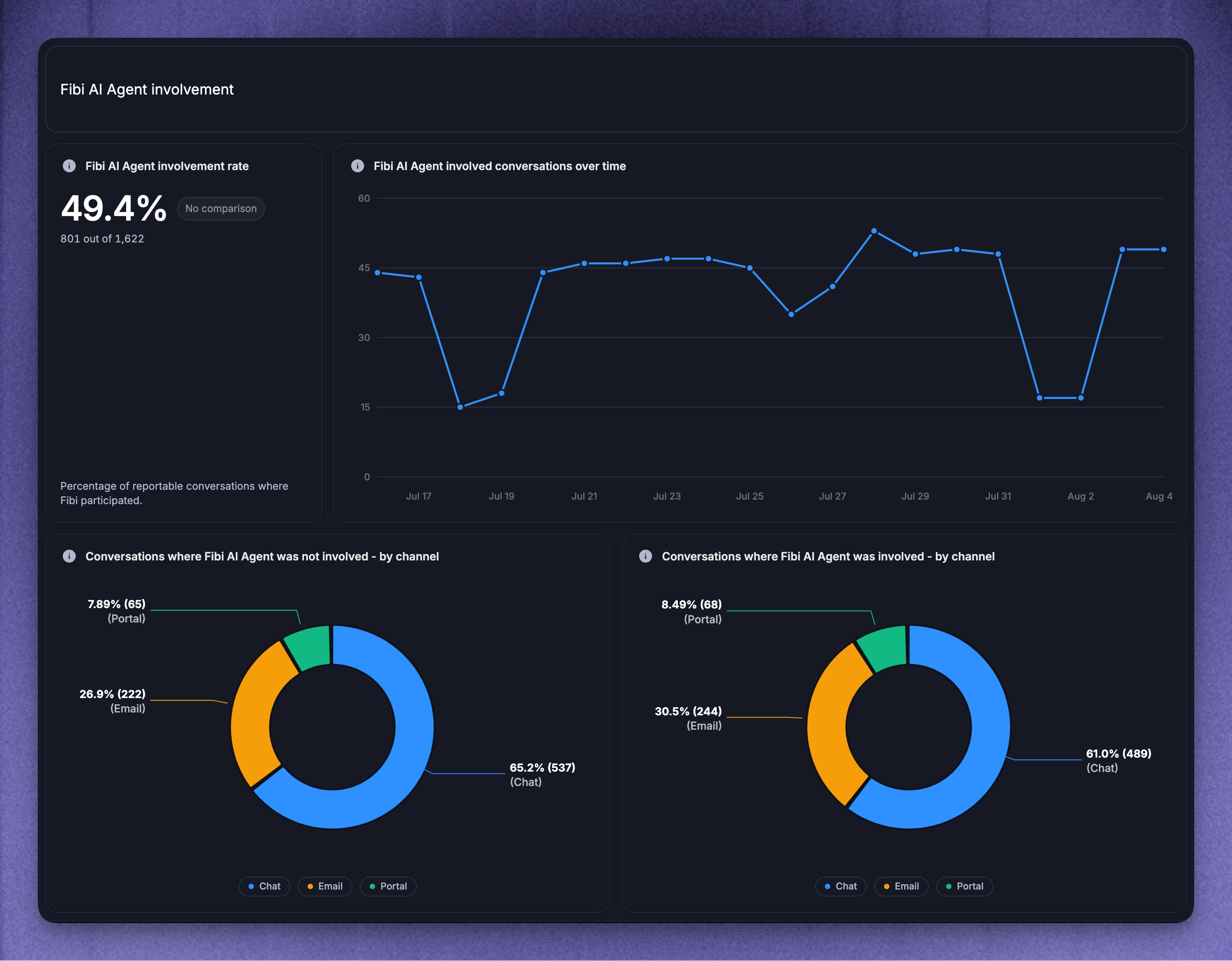
This section measures Fibi's reach:
‘Fibi AI Agent involvement rate’ - the share of reportable conversations where Fibi participated
‘Fibi AI Agent involved conversations over time’ - how that volume changes across the date range
Two donut charts split the same picture by channel:
‘Conversations where Fibi AI Agent was involved - by channel’
‘Conversations where Fibi AI Agent was not involved - by channel’
Use them to spot channels where conversations bypass Fibi entirely.
Fibi AI Agent resolutions
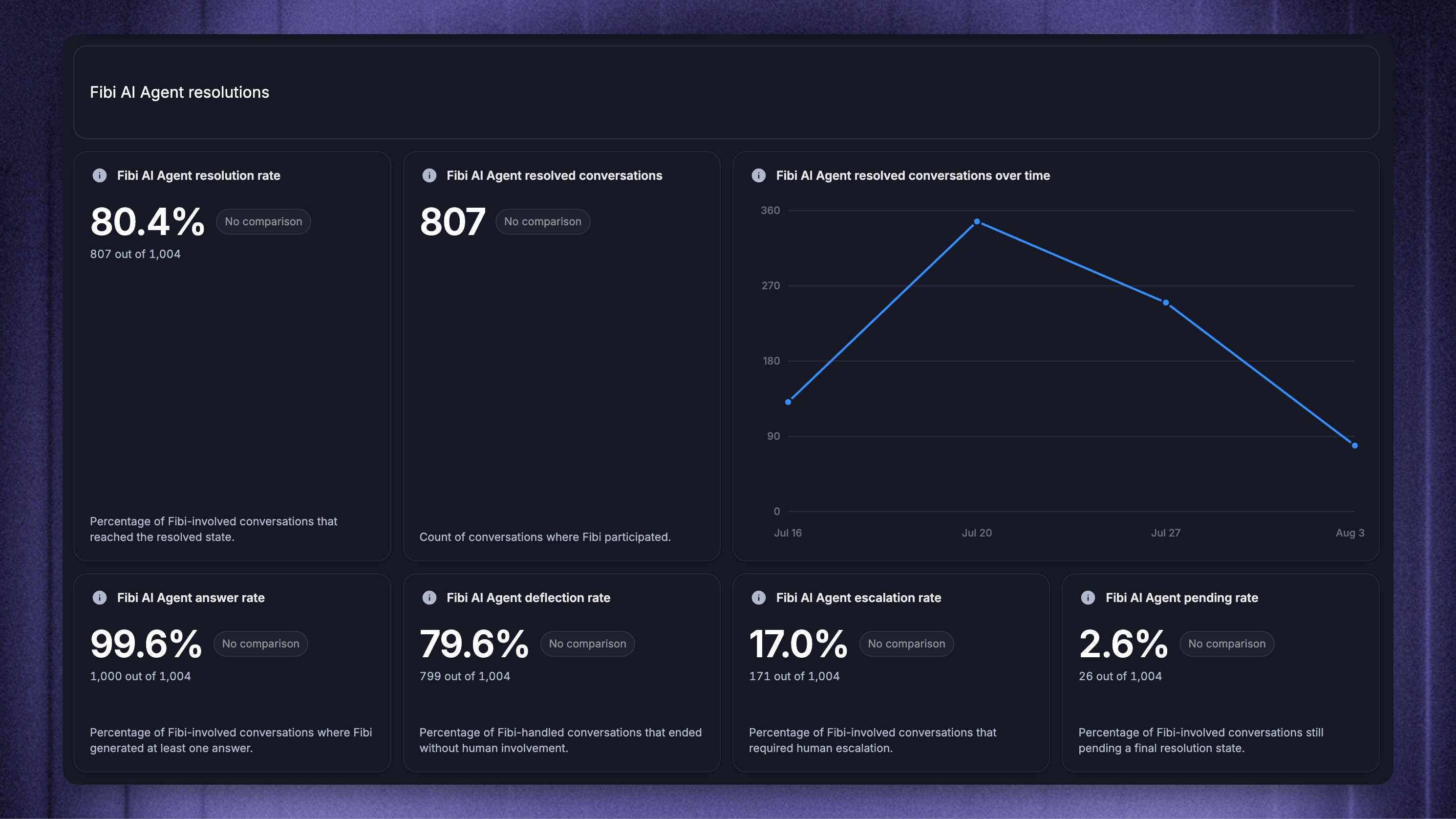
This section breaks down what happens inside Fibi's conversations:
‘Fibi AI Agent resolution rate’ - the share of Fibi-involved conversations Fibi resolved
‘Fibi AI Agent resolved conversations’ - the number of Fibi-involved conversations Fibi resolved
‘Fibi AI Agent resolved conversations over time’ - the resolved-conversation count across the date range
Four KPIs then show how Fibi-involved conversations progress:
‘Fibi AI Agent answer rate’ - the share of Fibi-involved conversations where Fibi generated at least one answer
‘Fibi AI Agent deflection rate’ - the share that ended without human involvement
‘Fibi AI Agent escalation rate’ - the share escalated to teammates
‘Fibi AI Agent pending rate’ - the share still waiting on a final resolution state
Resolution and handoff breakdowns
Use these breakdowns to understand how Fibi resolved conversations and why it handed them off:
AI Answers and Custom Answers - split resolutions by answers Fibi generated from your knowledge sources and answers you configured, each with its own resolution count and rate
Fibi handoff reason - separates handoffs caused by a usage cap, a teammate handoff, or an error
Fibi handoff trigger - shows the condition that caused the handoff, such as a customer request, your configuration, default behavior, a Procedure, a usage cap, or an error
Both handoff attributes are available in filters and breakdowns, and their values appear in drill-ins and exports.
Content performance
The ‘Fibi AI Agent content performance’ table ranks the knowledge sources Fibi used in its answers by ‘Fibi AI Agent involved conversations’ and ‘Fibi AI Agent resolved conversations’.
Note: Fibi can use more than one source in a conversation, so the same conversation can count under several sources and the rows can add up to more than the summary total.
Assumed and confirmed resolutions
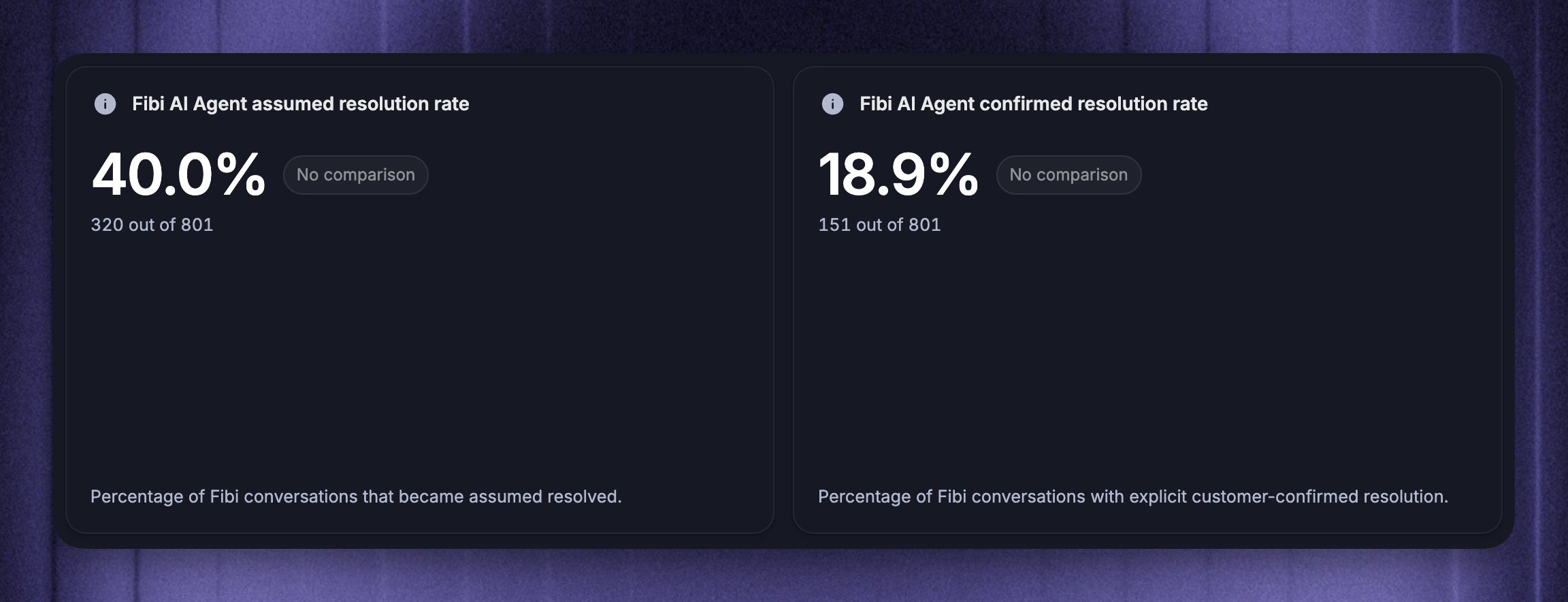
Two KPIs qualify the resolution number:
‘Fibi AI Agent assumed resolution rate’ - the percentage of Fibi conversations that became assumed resolved
‘Fibi AI Agent confirmed resolution rate’ - the percentage with explicit customer-confirmed resolution
Together they separate inferred resolutions from customer-confirmed resolutions.
Fibi AI Agent customer satisfaction
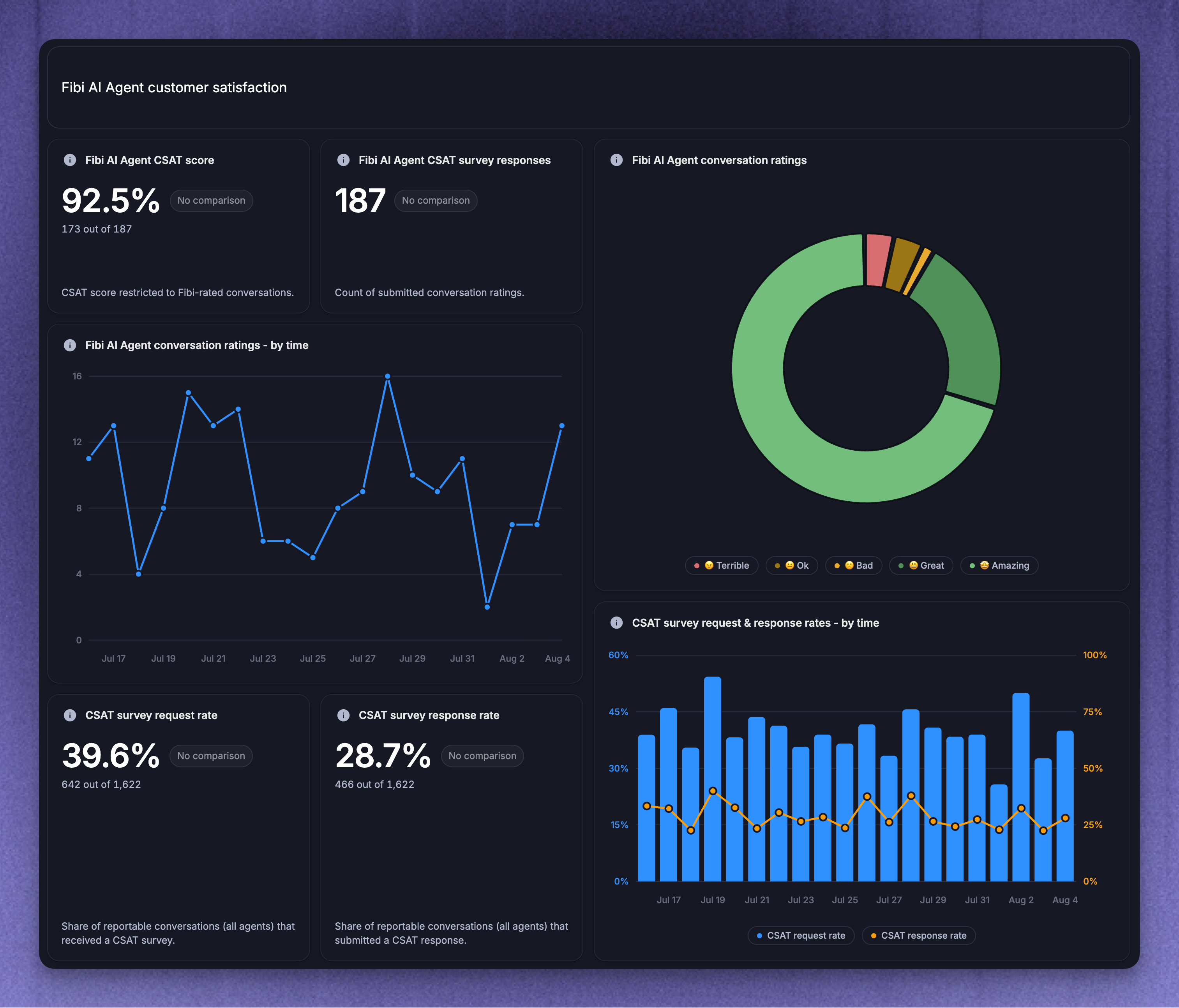
The last section covers ratings collected through Fibi CSAT. For a view across Fibi and your whole team, use Customer Satisfaction reporting. A rating counts toward Fibi when Rated agent type is Fibi AI Agent, meaning the customer rated Fibi’s handling rather than a teammate’s.
‘Fibi AI Agent CSAT score’ - the percentage of positive ratings out of all Fibi ratings
‘Fibi AI Agent CSAT survey responses’ - how many ratings came in
‘Fibi AI Agent conversation ratings’ - a donut splitting responses by rating label, from amazing to terrible
‘Fibi AI Agent conversation ratings - by time’ - rating volume over the date range
Customize this report
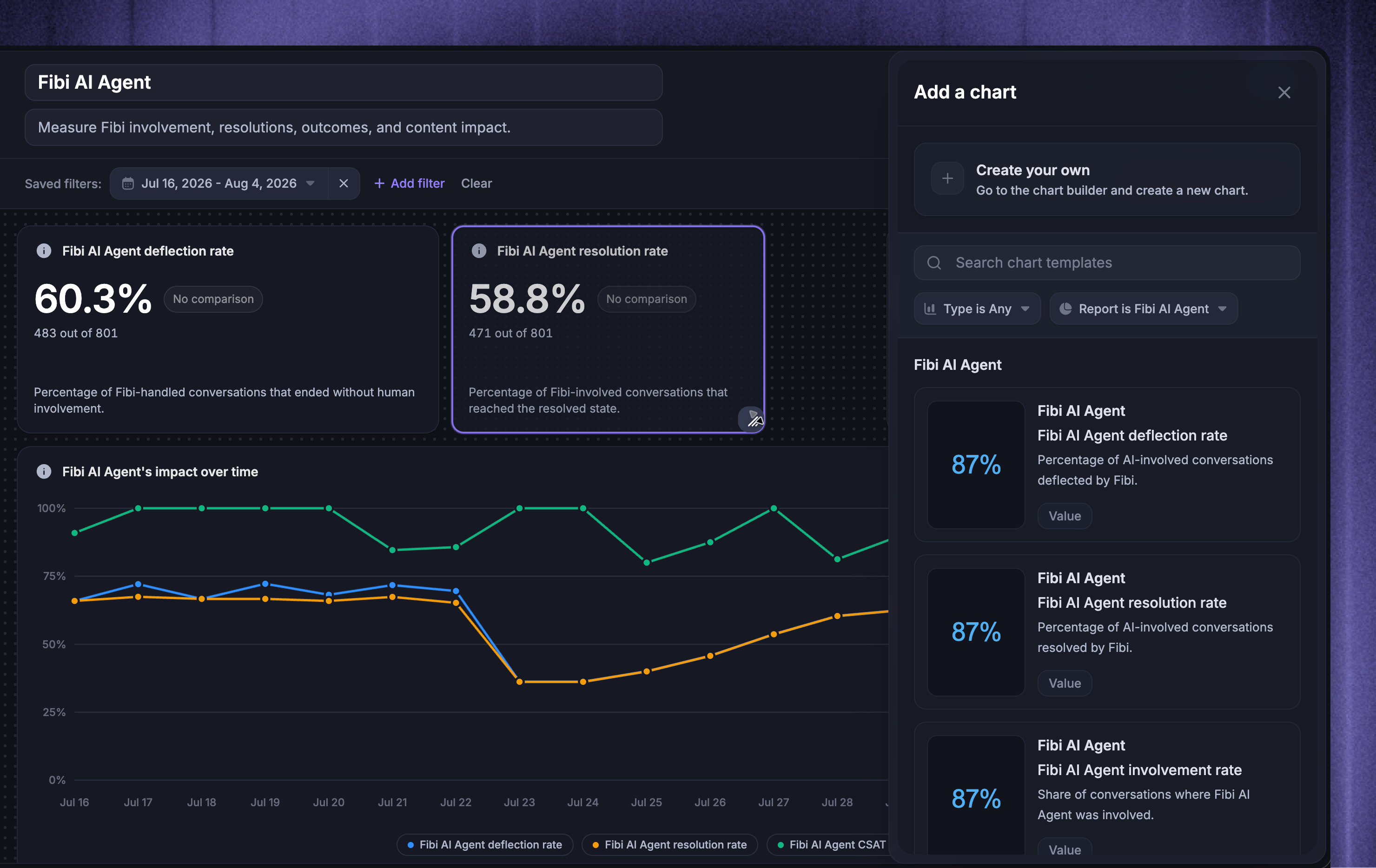
Click ‘Use this template’ to turn the template into your own report. Add, remove, or reconfigure any chart, change the date range, and filter the whole report, for example by Channel or Team.
Useful attributes for this template:
Fibi resolution state
Fibi answer type
Fibi handoff reason
Fibi handoff trigger
Fibi answer source title
Use these attributes to filter or break down your own charts. You can find every definition in Reporting metrics and attributes.
Learn more about customizing reports →
Fibi AI Agent report use cases
Find where Fibi is bypassed
Compare the involved and not-involved channel charts to find channels where conversations regularly bypass Fibi.
Diagnose escalations and handoffs
Use the outcome rates with ‘Fibi handoff reason’ and ‘Fibi handoff trigger’ to separate customer requests from configuration, usage-cap, and error-driven handoffs.
Improve Fibi's content
Sort ‘Fibi AI Agent content performance’ by involved conversations to find the sources Fibi relies on most, then compare their resolved conversations:
Keep Fibi's most-used content accurate and up to date as a priority
Review sources with many involved conversations but relatively few resolved conversations
Check underperforming content for missing, inaccurate, or ambiguous information
Review customer satisfaction
Use ‘Fibi AI Agent CSAT score’ together with its survey-response count to judge satisfaction without overlooking the sample size.
FAQs
What is the difference between assumed and confirmed resolutions?
What is the difference between assumed and confirmed resolutions?
A confirmed resolution means the customer explicitly confirmed that Fibi's answer resolved their question.
An assumed resolution means the conversation became resolved without that confirmation, for example when the customer left after Fibi's answer without asking for more help.
Both count toward the overall resolution rate.
Does a conversation still count as deflected if the customer comes back?
Does a conversation still count as deflected if the customer comes back?
Deflection is measured per conversation. A conversation counts as deflected while it ends without human involvement - if it is reopened and a teammate steps in, it stops counting as deflected.
A new conversation from the same customer is counted on its own and does not change how the earlier one is counted.
How is Fibi CSAT collected?
How is Fibi CSAT collected?
Enable Fibi CSAT in the ‘Let Fibi answer’ step that handles the conversation.
You can request a rating:
After Fibi resolves the conversation
Before Fibi hands the conversation to a teammate
In both situations
A rating counts toward Fibi when ‘Rated agent type’ is ‘Fibi AI Agent’.
Was this helpful?
Still need help? Ask the team